


A Map of the First Civilizations
For thousands of years, the lands between the Tigris and Euphrates rivers formed the heart of the ancient world. Here, the earliest cities rose from fertile plains, temples were built to honor powerful deities, and the foundations of civilization itself began to take shape.
The map above highlights several of the most important cities, sacred sites, and cultural centers of the ancient Near East. Places such as Uruk, Ur, Nineveh, and Eridu were not merely settlements, but the beating heart of early human civilization—centers of religion, governance, trade, and myth.
These cities were connected through complex networks of commerce, diplomacy, and conflict, forming one of the earliest interconnected cultural systems in history. Trade routes linked Mesopotamia with distant regions such as Anatolia, the Levant, and the Persian Gulf, allowing ideas, goods, and religious traditions to travel across vast distances.
Yet the landscape of the ancient world looked very different during the last Ice Age. Around 20,000 years ago, global sea levels were approximately 120 meters lower than they are today. Vast coastal plains existed where oceans now lie.
Because of this, some researchers have suggested that early settlements may once have existed along the ancient shores of the Persian Gulf basin, a region that was gradually flooded as the ice sheets melted and sea levels rose. If such settlements existed, their remains may now lie buried beneath the waters of the Gulf, hidden beneath layers of sediment.
In Mesopotamian mythology, the earliest wisdom was said to come from the Abzu, the primordial freshwater ocean beneath the earth ruled by the god Enki. According to ancient traditions, divine sages known as the Apkallu emerged from these waters to teach humanity the arts of civilization—writing, architecture, agriculture, and law.
Curiously, echoes of similar traditions appear far from Mesopotamia. In ancient Japanese mythology, cultural heroes such as Hoori and other early divine figures associated with the sea were believed to have connections to underwater realms like Ryūgū-jō, the palace beneath the ocean. In several traditions, knowledge and civilization are portrayed as emerging from the sea itself.
While these stories belong to mythology rather than archaeology, they reveal something fascinating about the ancient human imagination: across distant cultures, the waters of the deep were often seen as the birthplace of wisdom, life, and civilization.
Whether through myth or memory, these traditions suggest that the earliest chapters of human civilization may still lie partially hidden—beneath sand, beneath ruins, or perhaps beneath the sea itself.
.
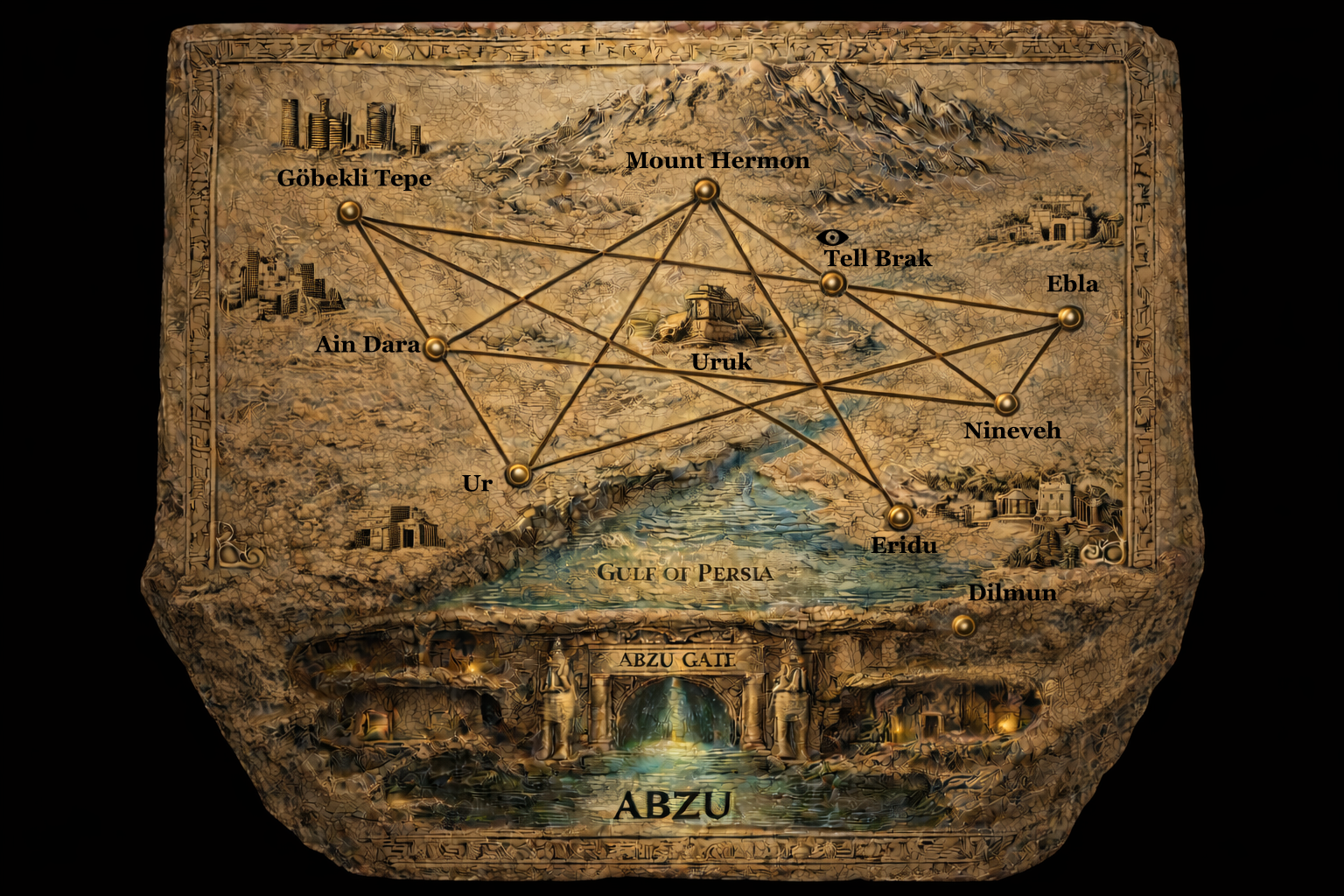
Key Cities and Sacred Sites of Ancient Mesopotamia
Göbekli Tepe
Located in modern-day southeastern Turkey, Göbekli Tepe is one of the oldest known ritual complexes in human history, dating to around 9600 BCE. Built long before the rise of cities or agriculture, the site consists of massive circular enclosures formed by T-shaped stone pillars, many decorated with carvings of animals and symbolic figures.
Scholars believe Göbekli Tepe served as a ceremonial or religious center, where early hunter-gatherer societies gathered for ritual activities. Its existence suggests that organized religion may have played a crucial role in the formation of early human communities, possibly even preceding the development of agriculture.
Because of its great antiquity, Göbekli Tepe is often described as the oldest temple complex ever discovered.
Mount Hermon
Mount Hermon rises on the border region between modern Syria, Lebanon, and Israel, forming one of the highest peaks in the ancient Near East. In ancient traditions, the mountain held deep symbolic significance as a cosmic boundary between heaven and earth.
In Jewish apocalyptic literature, particularly the Book of Enoch, Mount Hermon is described as the place where the Watchers—rebellious heavenly beings—descended to Earth. Because of this association, the mountain became linked with themes of divine transgression, forbidden knowledge, and the origin of the Nephilim.
Its towering presence over the surrounding lands made it a powerful symbol in ancient myth and religious imagination.
Tell Brak
Tell Brak, located in northeastern Syria, was one of the earliest large urban centers in northern Mesopotamia. Archaeological evidence suggests that the city flourished as early as 4000 BCE, making it one of the first examples of urban expansion outside southern Sumer.
The city was an important trade and administrative hub, connecting Mesopotamia with Anatolia and the Levant. One of its most unusual archaeological discoveries is the “Eye Temple,” named after thousands of small alabaster figurines with oversized eyes.
These figures were likely offerings to the city's protective deity and may symbolize vigilance, divine observation, or spiritual presence.
Ebla
The ancient city of Ebla, located in modern Syria, was one of the most powerful kingdoms of the Early Bronze Age (c. 2500–2300 BCE).
Ebla is particularly famous for the discovery of over 17,000 clay tablets written in cuneiform, which were found in its royal archives in the 1970s. These tablets contain records of diplomacy, trade, legal matters, and religious rituals, offering one of the richest glimpses into early state administration.
The city's chief deity was Kura, a somewhat mysterious god who served as the protector of the kingdom. Ebla maintained diplomatic and commercial ties with cities throughout Mesopotamia before eventually being destroyed, possibly by the Akkadian Empire.
Uruk
Uruk is widely considered one of the first true cities in human history, flourishing around 4000–3000 BCE in southern Mesopotamia.
It was the center of the Sumerian civilization and is closely associated with the development of cuneiform writing, the earliest known writing system.
The city was dedicated to the goddess Inanna (later known as Ishtar), the deity of love, war, and political power. Uruk was also home to monumental temples and ziggurats that dominated the city's skyline.
The legendary king Gilgamesh, hero of the Epic of Gilgamesh, is traditionally said to have ruled Uruk.
Ur
The city of Ur was one of the most important political and cultural centers of ancient Sumer, reaching its peak around 2100 BCE during the Third Dynasty of Ur.
Ur is famous for the Great Ziggurat of Ur, a massive stepped temple dedicated to the moon god Nanna (Sin). The city played a central role in trade networks that extended across the Persian Gulf and deep into the Near East.
Ur also holds importance in biblical tradition, as it is described in the Book of Genesis as the homeland of Abraham.
Nineveh
Nineveh, located on the eastern bank of the Tigris River, became one of the greatest cities of the Assyrian Empire.
During the reign of King Sennacherib (7th century BCE), Nineveh was transformed into a vast imperial capital with monumental palaces, walls, and gardens.
The city was famous for the Library of Ashurbanipal, which preserved thousands of clay tablets, including the most complete version of the Epic of Gilgamesh.
Nineveh eventually fell in 612 BCE when a coalition of Babylonians and Medes destroyed the city, marking the collapse of Assyrian imperial power.
Eridu
Eridu is considered by many scholars to be the oldest city in southern Mesopotamia, with origins dating back to around 5400 BCE.
In Sumerian mythology, Eridu was believed to be the first city created by the gods, making it one of the most sacred locations in early Mesopotamian religion.
The city's primary deity was Enki (Ea), the god of wisdom, water, creation, and hidden knowledge. Eridu was closely associated with the Abzu (Apsu), the primordial underground freshwater ocean believed to lie beneath the earth.
This mythological connection made Eridu a central place in Mesopotamian cosmology.
Dilmun
Dilmun was an ancient trading civilization located in what is now Bahrain and the eastern Arabian Gulf.
In Mesopotamian literature, Dilmun was described as a pure and sacred land, sometimes portrayed as a paradise-like place where disease and death were absent.
Historically, Dilmun functioned as a crucial commercial hub, connecting Mesopotamia with trade routes reaching the Indus Valley and Arabia. Goods such as copper, precious stones, and timber passed through its ports.
Because of its economic and mythological importance, Dilmun appears frequently in Sumerian myths, including stories associated with the god Enki.
Abzu (Apsu)
The Abzu was not a city but a cosmic concept in Mesopotamian cosmology. It referred to the vast underground ocean of fresh water believed to exist beneath the earth.
In Sumerian belief, the Abzu was the sacred domain of the god Enki, who ruled from a temple in Eridu. It represented the source of life, wisdom, and creative power.
Many temples in Mesopotamia included ritual basins symbolizing the waters of the Abzu, reinforcing the connection between sacred architecture and the cosmic order of the universe.


