


The Day Civilization Was Looted
The Attack on the Iraq National Museum (2003)
In April 2003, during the invasion of Iraq led by the United States and coalition forces, one of the most significant cultural catastrophes of the modern era unfolded quietly inside the Iraq National Museum in Baghdad.
Within days of the fall of Saddam Hussein’s regime, the museum — which housed some of the most important artifacts from the birth of civilization — was left
Looters entered the building and began removing or destroying thousands of objects that documented more than five millennia of human history.
What disappeared in those days was not merely property.
It was memory.
A Museum of the First Civilization![https://images.openai.com/static-rsc-3/qe-By7n1spKilyYF2PC5dtSMKeITWWRYHFPHG5xv04liL6Z9-xpXSs9Y8S61rTT2rhPb1ctOF9rD3BX7GJlcBmyaJeBleLfo9nQMCCHMDws?purpose=fullsize&v=1]()

The Iraq National Museum contained artifacts from Sumer, Akkad, Babylon, and Assyria — the earliest known complex societies in human history.
Many of these objects dated back over 5,000 years, to the time when writing, cities, and organized law first emerged in Mesopotamia.
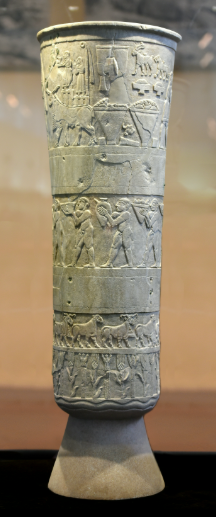
Among its most famous pieces was the Warka Vase, a carved alabaster vessel from the city of Uruk (c. 3200 BCE), depicting one of the earliest narrative scenes in human art.
The vase represents ritual offerings to the goddess Inanna and is widely considered one of the earliest examples of structured storytelling in visual form.
It also plays a role in the fictional universe of Architects of the Veil.
The Looting (April 2003)
As Baghdad fell, government authority collapsed almost overnight.
For several days, the museum remained essentially unguarded.
Looters broke display cases, smashed statues, and carried away artifacts small enough to transport.
Early estimates suggested up to 15,000 objects had been stolen.
Subsequent investigations later showed that the number of missing artifacts was smaller — but still devastating.
Some pieces were clearly taken by opportunistic looters.
Others, however, appeared to have been removed with suspicious precision, targeting specific storage rooms containing high-value antiquities.
This led some archaeologists to suspect that organized antiquities traffickers had exploited the chaos.
A Global Controversy
The looting sparked worldwide outrage.
For years before the invasion, archaeologists and museum specialists had warned that Iraqi cultural institutions would be vulnerable if the regime collapsed.
Despite these warnings, the museum was not immediately secured by coalition forces.
Critics argued that the protection of Iraq’s cultural heritage should have been treated as a strategic priority.
Others suggested that the chaos of the early days of the occupation made such protection difficult.
To this day, the question remains debated.
Was it simply a failure of planning?
Or something more complicated?
Recovery and Reopening
In the years following the looting, international efforts were launched to track and recover stolen artifacts.
Thousands of items were eventually returned through police investigations, customs seizures, and voluntary repatriations.
The Warka Vase itself was recovered in 2003, after being found abandoned near Baghdad.
The museum gradually reopened in stages:
- Partial reopening in 2009
- Long periods of closure due to instability
- Full reopening in 2015
Even today, recovery efforts continue.
Many artifacts remain missing.
A New Threat: ISIS
In 2015, the world watched in horror as the Islamic State released propaganda videos showing the destruction of ancient artifacts in Mosul’s museum.
Some of the objects destroyed were replicas.
Others were genuine antiquities.
While the Baghdad museum itself was spared, the videos reminded the world that the cultural heritage of Mesopotamia remains fragile.
When History Disappears
The looting of the Iraq National Museum is widely considered one of the greatest cultural losses of the early 21st century.
Many scholars compare it to the destruction of the National Museum of Brazil in 2018, which erased vast collections of scientific and historical knowledge.
Civilizations are not lost only through war.
Sometimes they vanish piece by piece.
One artifact.
One tablet.
One vase.
A Note from the Author
The events surrounding the Iraq Museum looting inspired elements of the world behind Architects of the Veil.
In the novel, the chaos of 2003 becomes the backdrop for a covert operation involving one of the museum’s most famous artifacts — the Warka Vase.
History leaves gaps.
Fiction sometimes explores what might have happened in those shadows.


